

Glass Marking Laser: How It Works & Industrial Applications
Introduction:Is Glass Marking Laser a Viable Industrial Technology?
Yes.Glass laser marking technology is a critical process in modern manufacturing. It achieves permanent and precise markings on glass in a non-contact, damage-free manner, perfectly addressing the challenge of marking brittle, transparent materials.
This technology combines permanence, high precision, efficiency, and versatility. Its core advantages include no consumables required, non-contact operation, and exceptional durability.
This makes it suitable for both the stringent traceability requirements in industries like medical devices and consumer electronics, and for brand decoration and anti-counterfeiting on premium products.
It offers both reliability and cost-effectiveness, applicable to scenarios ranging from mass production to specialized custom runs.

What“Marking” Means on Industrial Glass?
In industrial manufacturing, “marking” on glass is not merely putting a label on a surface. It is the process of bestowing a permanent, flawless, and functional identity without compromise. It answers the critical need for traceability, compliance, and branding on a material known for its fragility and clarity.
The Core Principle: Identity Without Alteration
Unlike engraving, which removes material to create tactile depth, industrial glass marking is defined by what it does not do: It does not crack, chip, or weaken the substrate. It does not create ridges that can trap contaminants. It does not interfere with the structural or optical integrity of the part.
Instead, a true glass marking laser works at a molecular level—often using a UV laser’s “cold” photons—to create a high-contrast, permanent change within the surface. The result is a mark that is:
Visually Perfect: Crisp logos, scannable barcodes, and legible alphanumeric text.
Physically Smooth: The surface remains as smooth as the original, meeting requirements for cleanability and sterility.
Permanently Fused: Withstand abrasion, cleaning solvents, and environmental exposure.
Why Choose Glass Marking Laser ?
Having established what glass laser marking is, the natural next question is: why should it be your chosen process? The answer lies not in the technology itself, but in the unique value proposition it delivers for modern manufacturing—a proposition defined by uncompromising quality, operational efficiency, and risk mitigation.
Choose laser marking when your priorities demand:
Zero-Compromise Quality: You cannot afford micro-cracks, chips, or any form of subsurface damage that could compromise the part's strength or function.
Absolute Process Integrity: The marking must not alter the cleanability, sterility, or optical clarity of the glass. The surface must remain as pristine as it was before marking.
Permanence as a Standard: Marks must withstand the entire product lifecycle—resisting abrasion, chemicals, and environmental exposure without fading or degrading.
Precision at Scale: You need micron-level accuracy and consistency for thousands of parts, enabling reliable automation and seamless integration into high-volume production lines.
Solving the "Untouchable" Challenge: The parts are too delicate, too small, or too critical for any contact-based or thermally aggressive marking method.
In essence, you choose laser marking when preserving the material's inherent perfection is as important as the mark itself.
It is the strategic choice for industries where failure is not an option, and where the mark must carry the same guarantee of reliability as the component it identifies.
This value-driven rationale is what makes it the indispensable solution across the most demanding sectors, as evidenced in the following real-world applications.
Industrial Application Examples of Glass Marking Laser
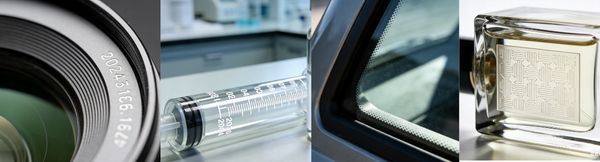
Marking tiny serial numbers and certification codes on camera lenses, sensor covers, and fiber optic connectors.
Advantage: Laser marking achieves permanent, micron-level precision without contact or stress, ensuring zero risk to the function and reliability of precision components.
Marking batch numbers and graduations (mandated for FDA/GMP traceability) on syringes, vials, and implantable devices.
Advantage:Laser marking creates marks that are fused with the glass substrate, resulting in a surface that is absolutely smooth, sterile, and chemically resistant—the only choice for meeting medical-grade safety and compliance.
Marking part numbers, VIN codes, and safety symbols on windows, lamp covers, and interior glass.
Advantage:Laser markings are embedded into the surface layer, offering exceptional weather and wear resistance, ensuring legibility throughout the product's entire lifecycle.
Marking invisible anti-counterfeit codes, personalized text, and intricate logos on perfume bottles, drinkware, and art pieces.
Advantage:Advantage:Laser marking can produce high-contrast, detailed patterns while preserving the glass's original smooth feel, and even enable "invisible" anti-counterfeiting, perfectly balancing brand identity, security needs, and premium tactile experience.
As you can see, whether in the medical, electronics, or automotive fields, the core requirements for glass marking all point to damage-free processing, high precision, and permanence.
Not all laser equipment can meet these demands.
Our UV Laser Marking Machine for glass is precisely engineered to address these specific industrial challenges, ensuring you can reliably replicate the application advantages described above.
Related Video:
How to Choose Laser Marking Machine?
This video serves as a practical guide to choosing a laser marking machine, covering key considerations like laser sources, machine size, and upgrades to help you make an informed decision.
Any Confusion and Questions about How to Glass Marking Laser in Glass
Conclusion
Choosing the right laser process depends on one key question: Are you aiming for visual identification or tactile modification?
Choose Laser MARKING When Your Goal is to:
Apply permanent, high-contrast identifiers (serial numbers, QR codes, logos).
Maintain the original smooth surface and structural integrity of the glass.
Meet strict hygienic or optical requirements (medical, optical, electronics components).
Enable product traceability and branding without physical alteration.
Do NOT Choose Marking if You Need:
Noticeable tactile depth, texture, or a matte finish (decorative glass, grip surfaces).
Material removal for functional purposes (creating grooves, light diffusion patterns, or deep engraving).
True 3D relief or artistic sculpting on glass.
Laser marking technology applies not only to glass but also to materials like wood, acrylic, plastic, metal and so on. For a complete overview of applications across materials, see our Laser Application Overview.