

Laser Engraving Cork: The Commercial Production Guide
Why Cork Is a High-Margin Material for Laser Engraving Businesses
The Market Opportunity Is Real — and Growing
Cork has quietly become one of the most profitable materials running through commercial laser engraving shops. The math is hard to argue with: bulk cork coaster blanks cost $0.30–$0.80 per unit. Laser engraved, the same coaster sells wholesale at $2.50–$5.00 and retail at $8–$15 with a logo or personalization. That spread — on a material that engraves fast, requires minimal power, and needs no secondary finishing — makes cork a serious line item for any production facility.
Demand is not coming from one direction. Corporate gifting programs run bulk orders of 500 to 5,000 branded coasters. Wineries and craft breweries treat engraved cork as a natural extension of their brand. Wedding planners and event companies source custom laser engraved cork coasters by the hundreds. Restaurants and hotels embed branded coasters into their table programs. These are repeat buyers, and they buy at volume.
Why CO2 Laser and Cork Are a Natural Fit
Cork comes from the bark of the cork oak tree. Its structure is made up of millions of tiny air-filled cells composed primarily of suberin — a waxy, organic compound. CO2 laser energy at 10,600nm is absorbed by organic materials almost perfectly. When the beam contacts cork, it vaporizes the surface cleanly and precisely, producing a sharp, high-contrast dark mark against the natural tan background.
No ink. No paint. No secondary process. Just clean, fast engraving that holds up to handling and looks premium straight off the machine.
CO2 vs. Diode Lasers for Cork: Why Industrial CO2 Wins at Scale
How the Two Technologies Handle Cork Differently
CO2 lasers operate at 10,600nm — deep infrared. Cork's organic, cellulose-based structure absorbs this wavelength with very high efficiency. Energy lands precisely at the surface, vaporization is controlled, and heat spread into adjacent material is minimal. That's why CO2 engraved cork comes off the machine with defined edges and a clean surrounding surface.
Diode lasers work at 450–500nm in the visible blue spectrum. Cork absorbs this wavelength less efficiently, which means more energy is needed to achieve the same engraving depth, more heat builds up over a long production run, and edge definition suffers on finer design elements. For a hobbyist running 20 coasters, a diode machine gets the job done. For a production floor running 300 a day, the limitations stack up fast.
Where Diode Lasers Hit Their Ceiling
The problem with diode lasers in commercial cork production is not a single failure point — it's gradual degradation across a long run. Thermal buildup affects engraving consistency from piece to piece. More frequent rest cycles reduce daily output. Edge quality on fine text and logos becomes harder to hold across a large batch.
For any operation where consistency across volume is a requirement — and in commercial production, it always is — industrial CO2 is the only technology that delivers it reliably.
Laser Power for Cork Engraving:
100W vs. 150W vs. 300W
The Counterintuitive Rule About Higher Wattage
A common misconception is that higher wattage means "overpowering" the material. In reality, it means running cleaner. For delicate materials like cork, stable energy delivery is more critical than brute force.
Running a 150W tube at 17% power often delivers more consistent energy than a 100W tube at 25%. This precision minimizes heat-affected zones, ensuring tighter edges and significantly dropping the scorch risk.

1. 100W: The Startup Choice
Best for mixed-material workshops or businesses building their first cork production line. It offers a balanced initial investment while maintaining high quality for standard thicknesses.
- Speed: 500–650mm/s
- Throughput: 220–300 units/hr
- Ideal for: Low-volume custom orders
2. 150W: The Wholesale Standard
This is the "sweet spot" for dedicated production. The increased wattage allows for single-pass engraving on 5-6mm thick cork, which effectively doubles the output compared to lower power systems requiring two passes.
- Speed: 700–900mm/s
- Throughput: 350–480 units/hr
- Ideal for: Mid-to-high volume wholesale
3. 300W: Industrial Manufacturing
Designed for multi-shift operations and large-format batch layouts. By utilizing multi-row fixtures, the 300W system maximizes every second of the duty cycle for extreme throughput.
- Speed: 900–1,200mm/s
- Throughput: 600–800+ units/hr
- Ideal for: High-volume manufacturing
Eliminating Burn Marks on Cork:
What Actually Works
Why Scorch Marks Happen
Cork's open-cell structure does not dissipate heat the way denser materials do. Instead of traveling downward, laser-induced heat spreads laterally through the cellular network around the engraving path. Too much energy — from excessive power, insufficient speed, or inconsistent beam output — and that lateral spread shows up as a discolored halo around the engraved area. The cork surface darkens where it should stay clean, and the piece is a reject.
The Tape Trick — and Why It Does Not Scale
A common fix you will find in online forums and hobbyist guides is masking tape. Apply low-tack tape over the cork before engraving, remove it after, and the surface stays clean. It works, to a degree — the tape absorbs some surface heat and keeps smoke residue off the surrounding material.
But in a commercial environment processing hundreds of coasters per shift, manually taping and peeling every single unit is not a production workflow. It is a bottleneck. More importantly, it treats the symptom rather than the cause. The root problem is that the machine is not delivering energy with sufficient precision and stability.
The Industrial Machine Solution
On a properly specified industrial CO2 machine, burn-free cork engraving is an outcome of equipment design, not operator workarounds. Three mechanisms work together to make it consistent:
Stable power delivery: Industrial CO2 systems maintain power output within ±1% across the full job duration. That level of consistency eliminates the micro-fluctuations that cause localized hot spots on sensitive materials like cork.
Constant optical path design: As the laser head travels across a wide working area, the distance between the laser source and the material changes. A constant optical path system keeps beam characteristics identical from corner to corner. This is the difference between consistent quality across a full-bed layout.
Autofocus: Even within a single batch, cork blanks vary in thickness by 0.2–0.5mm. Autofocus adjusts the Z-axis to maintain the laser at the correct focal distance for each piece, ensuring consistent power density and results.
| Feature | CO₂ Laser Cutting | CNC Oscillating Knife |
|---|---|---|
| Minimum Detail | 1–2 mm precision | Around 10 mm limit |
| Edge Quality | Fused edges or slight charring | Clean cut, no burn marks |
| Best For | Logos, fine text, halftone acoustic panels | Large shapes and standard patterns |
| Tooling | No tooling required | No tooling required |
| Design Flexibility | Very high — complex geometry supported | Limited by blade size |
Source: MimoWork internal testing & application data.
Quick Answer (Snippet Ready)
CO₂ laser cutting is best for fine details, logos, and halftone panels. CNC oscillating knife cutting is best for large shapes and clean-edge production.
Request a test cut on your crok.
Smoke Extraction for Cork Production
What Cork Combustion Actually Produces
Cork combustion generates fine organic particulate, carbon ash, and volatile compounds from the suberin cell structure. The smell is distinct and the particulate load during a high-volume production run is substantial. Managing this is not just a comfort issue — it directly affects engraving quality and machine performance.
The Lens Contamination Problem
The most damaging quality risk from poor extraction is not what most operators expect. It is lens contamination. Cork ash is fine-grained and adhesive. During a sustained production run without proper airflow, particulate deposits accumulate on the focusing lens layer by layer.
The result is gradual quality drift — the first 50 coasters in a run look sharp and clean, while the last 50 appear lighter, softer, and inconsistent. Operators often chase this problem by incorrectly adjusting speed and power settings when the actual fix is simply cleaning the lens.
How Proper Extraction Works
The solution runs on two systems working simultaneously:
- The exhaust fan: Creates negative pressure inside the machine enclosure, continuously pulling smoke and particulate out of the chamber. For 100W–300W machines, the extraction capacity must be sufficient to clear the enclosure volume multiple times per minute.
- The vacuum working table: Draws smoke downward through the honeycomb surface immediately as it is generated. This is particularly effective for cork because it removes combustion byproducts from the engraving zone in real time, before they can travel upward toward the optics.
MimoWork's Flatbed Laser Cutter 130 and 130L both incorporate integrated exhaust systems and support honeycomb working table configurations, providing production-ready extraction without needing extra filtration units.
Lens Maintenance Schedule
For dedicated cork production, inspect the focusing lens every 4 hours of continuous operation and clean at the first sign of haze or deposit. A clean lens on a well-maintained machine performs identically on day one and day one hundred. A contaminated lens costs you quality on every job until it is addressed.
Cut & Engrave Wood Tutorial | CO2 Laser Machine
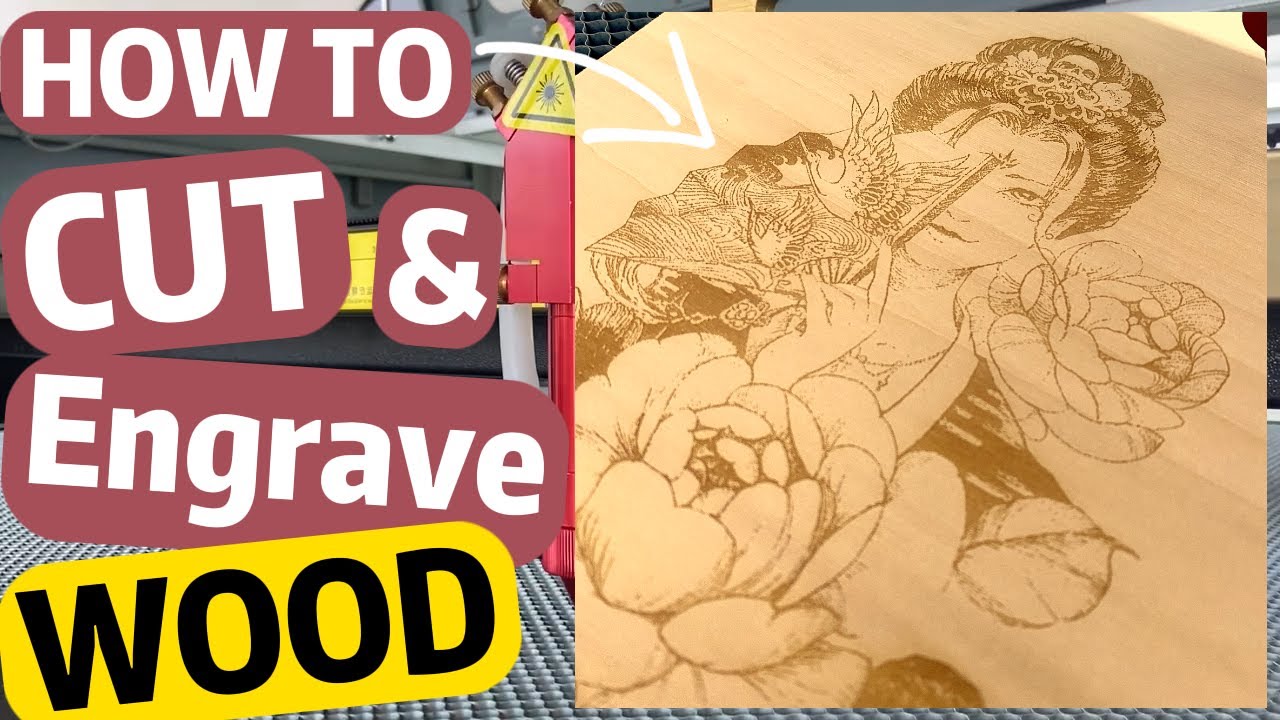
Learn how to laser cut and engrave wood with a CO2 laser machine in this quick guide. Discover practical tips, key considerations, and how wood laser processing can open the door to a profitable woodworking business.
MimoWork Machines for Cork Coaster Production
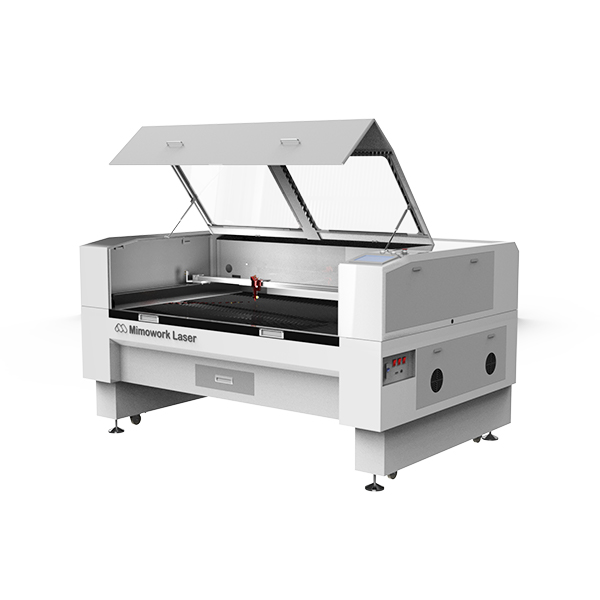
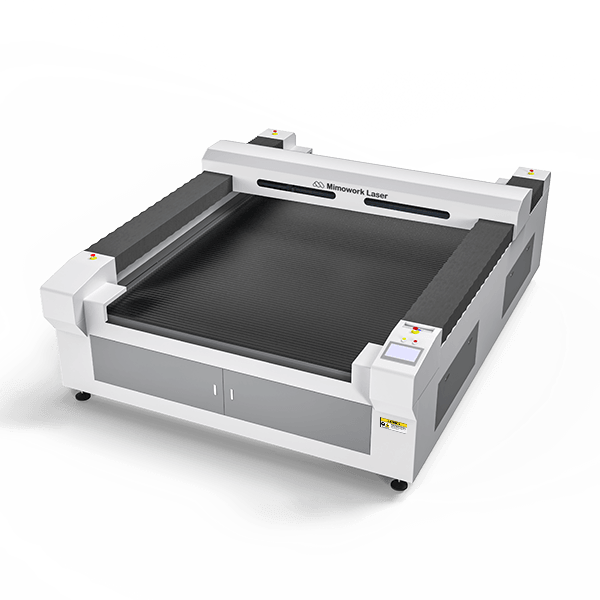
Matching machine to production volume is straightforward once you know what your operation needs. MimoWork's Flatbed Laser Cutter 130 and 130L cover the full range of commercial cork engraving requirements, from dedicated mid-volume production lines to large-format high-throughput manufacturing.
Which Machine Is Right for Your Operation
The Flatbed 130 is the right machine if you are building a cork production line, running cork alongside other materials, or entering this market with a scalable foundation. A 4×6 fixture layout on the 130's working area holds 24 standard 4-inch coasters per cycle. At 150W, that cycle runs in under 4 minutes for a typical logo fill — giving you a throughput that handles serious wholesale volume without overbuilding your initial investment.
The Flatbed 130L is built for operations where cork is the primary production focus and daily output targets are high. The 1300×2500mm table supports fixture layouts of 40–50 coasters per cycle or more, and the standard ball screw and servo motor transmission maintains speed and positional accuracy at that scale. If your orders regularly run above 500 units per day, the 130L removes the working area as a limiting factor.
Tell us your needs—we’ll match the right machine.
Batch Production Workflow: Jigs, Layouts and Throughput
Fixture Jigs: The Fastest Way to Add Capacity
A fixture jig is a holding plate — typically cut from 3mm acrylic or MDF — with recessed pockets that position each cork coaster in an exact location. With a saved home position, the operator simply loads the jig and runs the job. No per-unit alignment. No repositioning between cycles.
Eliminating just 6 seconds of alignment per coaster recovers nearly 40 minutes of net production time across a 400-unit day. We recommend 5–8mm clearance between pockets to prevent heat accumulation during high-speed engraving.
Build Your Batch Files for the Full Jig
Run your entire jig layout as a single file (e.g., 24 coasters as one job). This ensures consistent speed and acceleration profiles across every piece. Machine motion consistency is directly linked to engraving depth; variation in gantry acceleration can cause subtle darkness differences if files are processed individually.
Cork Engraving Parameter Reference
Note: These are starting parameters for 150W CO2 systems. Always run a test grid on new material batches.
| Material | Speed (mm/s) | Power (150W) | Passes | DPI |
|---|---|---|---|---|
| 3mm Cork | 600–700 | 15–20% | 1 | 300 |
| 4mm Cork | 500–600 | 18–23% | 1 | 300 |
| 6mm Cork | 400–500 | 22–28% | 1–2 | 300–400 |
| 2mm Sheet | 750–850 | 12–16% | 1 | 250 |
Keep the Machine Clean During Long Runs
Cork generates more fine particulate than wood or acrylic. For sustained production, build these intervals into your shift: compressed air blow-down every 90–120 minutes, lens inspection every 4 hours, and a full wipe-down at shift end. Quality drift on late-run batches is almost always a maintenance issue, not a parameter issue.
File Preparation for Cork Engraving Production
Why 300 DPI Is the Right Resolution for Cork
300 DPI is the production standard for cork. Cork's cellular structure limits its ability to resolve fine detail below approximately 0.3mm. Pushing to 400 or 500 DPI adds 30–65% to your job time with no visible gain in quality. At 300 DPI, a standard 4-inch coaster typically runs in 60–90 seconds.
Vector vs. Raster: Match the Mode to the Design
Text, logos, and clean line-based graphics should remain in vector mode for mathematically precise edges. Use raster mode for photographic images and gradients. For most commercial work, a hybrid approach works best: vector for sharp outlines and raster fill for solid areas.
Minimum Line Weight and Text Size
Maintain a minimum line weight of 0.5pt at final size; anything thinner may appear broken due to the cork's natural texture. For text, the practical minimums are 8pt for serif fonts and 6pt for clean sans-serif fonts to ensure legibility after engraving.
Grayscale Compensation for Photo Engraving
Cork tends to over-darken at mid-tones. For photographic or halftone designs, reduce image contrast by 15–20% before processing. This prevents mid-tone areas from collapsing into solid dark fills and preserves tonal separation in the final engraving.
Commercial Applications:
Where Laser Engraved Cork Sells
Corporate Gifting: The Highest-Volume Single Segment
Corporate buyers purchase branded cork coasters in quantity — 200 to 2,000 units per order is typical. These buyers value reliability and consistency: identical quality across the full order and correct artwork reproduction. Industrial equipment with stable power delivery lets you guarantee this consistency on a 1,500-unit run the same way you would on a small sample.
Wineries, Breweries and Distilleries
Cork is a natural fit for this segment. Wineries and craft breweries use engraved cork as tasting room merchandise and hospitality items. The aesthetic standard here is high — requiring fine typography and detailed logos. This is a strong repeat-purchase market where initial orders often evolve into long-term reorder relationships.
Wedding and Event Industry
Personalized cork coasters are a top performer in wedding favors, with orders ranging from 50 to 500 units. Since artwork varies between every event, efficient file management and fast fixture changeover are more critical here than single-design mass production. Industrial workflows handle these transitions seamlessly.
Restaurant and Hospitality Brands
Opening orders for restaurant groups or hotel brands can run 1,000–5,000 units. Buyers in this channel evaluate suppliers on lead time commitments and the ability to match previous orders exactly — areas where documented industrial parameters provide a clear advantage.
Promotional Products Industry
Distributors generate a continuous pipeline of orders for functional, sustainable, and visually impactful branded merchandise. To become an approved supplier, you must demonstrate consistent quality and production volume capability — results that come from professional-grade equipment.
E-commerce and Direct Retail
Direct-to-consumer margins are highly attractive: a coaster costing under $1 to produce can retail for $8–$15. Scaling this channel requires fast, repeatable short-run production with low per-unit cycle times, which is exactly what an optimized industrial CO2 machine handles best.
Frequently Asked Questions
An industrial CO2 laser in the 100W–300W range is the right tool for commercial cork engraving. CO2 wavelength is absorbed efficiently by cork's organic structure, producing clean, high-contrast results with minimal heat spread. For production volumes above 150 units per day, a machine with constant optical path design and integrated extraction — like the MimoWork Flatbed 130 or 130L — delivers the consistency that commercial output requires.
On a 150W CO2 machine, start with 600–700mm/s speed, 15–20% power, 300 DPI, single pass for 3mm cork coasters. Always run a test grid on a new cork batch before committing to full production — density varies between suppliers and affects your optimal parameters.
Controlled surface carbonization is what creates the dark engraved mark on cork — that is the process working correctly. Unintended scorch halos and burn marks are a machine precision and parameter issue, not an inherent property of cork. With stable power delivery, autofocus, and correct settings, cork engraves cleanly with no discoloration outside the intended engraving area.
Yes. Prepare the image in grayscale and reduce contrast by 15–20% to compensate for cork's tendency to over-darken at mid-tones. Engrave at 300–400 DPI. Results are best on flat, uniform-density cork blanks rather than heavily textured surfaces.
On the MimoWork Flatbed 130 at 150W with a 24-unit fixture jig, expect 350–450 coasters per hour for a standard logo fill on 4-inch blanks, accounting for load and unload time. On the Flatbed 130L with a larger multi-row layout, 600+ per hour is achievable.
Run the integrated exhaust fan at full capacity throughout the production run, keep the vacuum table active to pull smoke downward at the source, and inspect the focusing lens every 4 hours. These three steps together prevent the gradual quality drift that affects long production runs on cork.
Most commercial operations find orders of 100 units and above deliver strong margins on laser engraved cork coasters. Fixture-based production keeps per-unit machine time low at that volume, and cork's low material cost keeps input costs minimal. A healthy cork engraving business typically runs on a mix of recurring short runs — 50 to 200 units from repeat clients — and periodic larger corporate or hospitality orders in the 500 to 2,000 unit range.
Related Articles


Send your material details and get a usable cutting setup.
Post time: Apr-30-2026