

Laser Cutting Kite Fabric
Identify the Kite Fabric and Confirm Cutting Suitability

Kite fabric is an application category rather than a single material. A kite panel may use woven polyester or nylon, ripstop fabric, laminated membrane, reinforcing cloth, film, coating, adhesive, or a combination of several layers. These constructions may respond differently to thermal cutting.
| Information to Confirm | Details |
|---|---|
| Supplier and Grade | Exact commercial product and supplier specification |
| Base Material | Polyester, nylon or another identified fiber or film |
| Construction | Woven, ripstop, laminated, reinforced or membrane construction |
| Surface Treatment | Coating, finish, print or other surface layer |
| Combined Layers | Film, adhesive, backing, reinforcement or seam material |
| Material Format | Thickness, weight, number of layers, sheet or roll format |
For example, a cutting record for an uncoated ripstop polyester should not be applied automatically to a laminated, adhesive-backed, or reinforced fabric. The supplier grade and complete construction must match before the recorded result can be treated as applicable.
Suitability status: If no approved cutting record matches the exact material and construction, laser-cutting suitability remains unverified. Results for Dacron, ripstop polyester, ripstop nylon, Mylar, or another kite material should not be applied automatically to a different grade or construction.
Cutting Results to Confirm for Kite Fabric

Clean cutting edge

Flexible shape cutting

Auto-feeding fabric
Cut Completion and Dimensions
Confirm that the applicable record shows complete separation without missed sections or unwanted connections. Review the finished panel dimensions, contour accuracy, feature size, openings, and required tolerance.
Coating and Lamination
For coated or laminated kite fabric, confirm whether cutting affected the coating, membrane, adhesive, backing, or bond between layers. Relevant conditions include edge lifting, delamination, exposed adhesive, film distortion, and smoke deposition.
Assembly Compatibility
Confirm that the cut panel remains suitable for the required sewing, bonding, welding, reinforcement, or other assembly process. Edge thickness, residue, shrinkage, and dimensional changes may affect subsequent construction.
Edge and Thermal Response
Review the recorded edge for melting, hardening, shrinkage, discoloration, loose fibers, residue, or an uneven cut line. Different fibers, coatings, films, and reinforcing layers may produce different edge conditions.
Retained Material Function
Confirm which functions must remain after cutting, such as flexibility, required strength, air or water resistance, dimensional stability, or compatibility with the intended kite application. A visually clean edge does not by itself confirm retained performance.
Production Relevance
Production time should only be compared when the existing record matches the actual material, panel geometry, number of layers, positioning method, feeding arrangement, and machine configuration. Machine travel speed alone does not represent total production output.
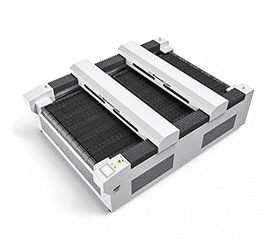
Kite Fabric Laser Cutting Machine



Video Display - how to laser cut kite fabric
Discover how laser cutting is used in kitesurfing kite production. This video demonstrates the precise and efficient cutting of various materials, including Dacron, ripstop polyester, and nylon, showcasing the laser cutter's versatility and high-quality results.
This video documents the material and machine configuration shown in the demonstration. It does not confirm that every Dacron, polyester, nylon, coated, laminated, or reinforced kite fabric will produce the same cutting result.
Video Display - Laser Cutting Kite Fabric
This video shows CO₂ laser cutting of the polyester membrane sample used in the demonstration. The recorded result applies to that sample and its documented configuration; it should not be extended automatically to other membranes, coatings, thicknesses, or kite constructions.
Kite Applications for laser cutter
Application suitability depends on more than the product name. Confirm the exact material grade, panel dimensions, required tolerance, load or functional requirement, exposure environment, reinforcement layout, and sewing, bonding, or welding method for the intended application.
• Kitesurfing
• Windsurfing
• Wing foil
• Foiling kite
• LEI kite (inflatable kite)
• Paraglider (parachute glider)
• Snow kite
• Land kite
• Wetsuit
• Other outdoor gears
An approved record for one kite application should not be treated as evidence for another application with different materials, construction, loads, or assembly requirements.

Kite Fabric Records and Material Boundaries
Kitesurfing deriving from the 20th century was evolving and developed some reliable materials to guarantee using safety as well as surfing experience.
The material names below identify categories used in kite and related outdoor applications; they do not confirm universal laser-cutting suitability. Apply an existing cutting record only when the supplier grade, construction, coating, thickness, number of layers, and required result match the actual material.