

Laser Engraving Golf Balls: UV Laser vs. Diode Laser
How UV and Diode Lasers Engrave Golf Balls
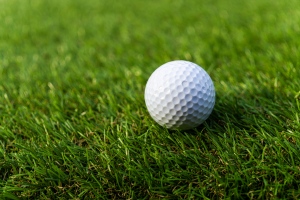
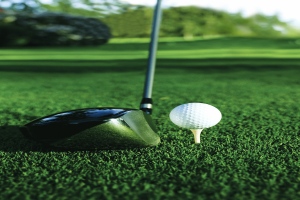
The two laser types work in fundamentally different ways.
UV lasers (355nm wavelength) are cold lasers that process materials by directly breaking molecular bonds with high-energy photons. The heat-affected zone is minimal, causing no significant thermal damage to surrounding material. This makes UV lasers ideal for processing heat-sensitive golf ball cover materials. A patented technology also mentions that excess material on golf ball surfaces can be removed using laser heat, with CO₂ being a common choice—but UV lasers have an advantage in fine marking due to their cold processing characteristics.
Diode lasers (~445nm wavelength) are thermal lasers that melt or vaporize material through high heat. Since golf ball surfaces are typically white or light-colored, diode laser energy is easily reflected and poorly absorbed.
UV vs. Diode Laser forLaser engrave Golf Balls: A Direct Comparison
| Comparison Dimension | UV Laser | Diode Laser |
|---|---|---|
| Engraving Effect | Precise, recessed, permanent mark; suitable for actual gameplay | Often raised or melted marks; primarily decorative, not for gameplay |
| Engraving Speed | Faster, optimized for production | Slower; less efficient for any kind of batch work |
| Operation Steps | Software setup + position ball + engrave. A golf ball jig is recommended for both to ensure consistent positioning | Same steps, but often requires more trial and error to find acceptable settings |
| Equipment Price | High initial investment | Low initial investment |
Overall, UV lasers lead across the board in quality, speed, and production stability — at the cost of higher equipment investment. Diode lasers, on the other hand, have only one advantage: affordability, making them better suited for hobbyists on a budget who want to get started.
Can a Diode Laser-Engraved Golf Ball Be Used on the Course?
The answer is no. There is a crucial distinction between a ball that is engraved and one that is simply marked with a surface treatment. According to a patent for laser marking golf balls, the process of material ablation removes surface material, leaving an image "machined or engraved within the cover layer". This permanent recess is very different from the melted or textured surface created by a diode laser.
Material ablation vs. surface melting: UV lasers remove material layer by layer through cold ablation, creating a true engraved recess with clean, defined edges. Diode lasers, in contrast, merely melt or discolor the surface, resulting in a raised or textured mark that is not a true engraving.
UV vs. diode laser engraving: A properly UV-engraved ball can meet the governing bodies' standards, but a diode-laser engraved ball rarely will. The heat-affected zone and surface deformation from diode lasers are far more likely to alter the ball's flight characteristics and violate equipment rules.
Application Scenarios for UV and Diode Laser Golf Ball Engraving
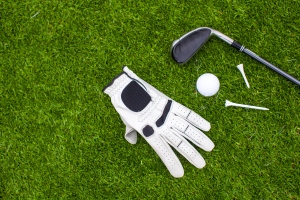
| Application | UV Laser | Diode Laser |
|---|---|---|
| Personalized Gifts | Professional-grade results for high-end customization | Works, but results depend on coating quality |
| Commercial Customization | Fast, suitable for batch orders, scalable production | Slow, not suitable for volume processing |
| Brand Logo Engraving | High contrast, sharp and clear | Logo clarity affected by coating uniformity |
| Tournament-Playable Balls | Cold processing; does not compromise ball structure | Thermal effects may affect ball performance |
| Hobbyist Use | Higher cost; suitable for professional users | Low cost; ideal for personal experimentation |
If you plan to offer golf ball engraving as a commercial service, UV laser is the more reliable and professional choice. If you are experimenting personally or on a limited budget, a diode laser can serve as an entry-level option—but be aware of the complexity of the workflow and the limitations of the results.
The key advantages of UV lasers are: no coating required, direct engraving, fine detail, fast speed, and minimal material impact—making them the more ideal tool for golf ball engraving.
Want to grow your business? Start laser engraving golf clubs.
UV Laser Marking Machine Recommendations
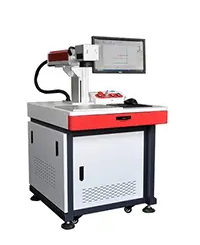
| Parameter | Details |
|---|---|
| Available Power | 3W, 5W, 10W |
| Engraving Depth (golf ball, multiple passes) |
0.01-0.05mm (3W) 0.05-0.1mm (5W/10W) * Cold process, shallow depth - mainly to avoid damaging the ball surface |
| Application Scenarios |
Golf balls: personalized logos, numbers, player names, brand marks, tournament branding Other golf customizations: golf tees, ball markers, divot tools, club head covers, scorecard holders, golf bag tags, trophy plates, putting green markers |
Related Video
How to Set up EZCad Rotary
Want to see the full process? Check out our YouTube tutorials for practical laser engraving. Using a laser engraver with rotary attachment is easier than you think once you see it in action.

FAQ
A: Highly recommended. Golf balls are spherical objects. Without a rotary axis, the laser can only focus on a single plane, making it impossible to achieve uniform engraving across the curved surface. A rotary attachment allows the ball to rotate during engraving, ensuring consistent focus and uniform results across the entire surface. Without it, the engraving area is severely limited.
A:Diode laser engraving on golf balls typically requires a dark coating or laser marking spray to help absorb the laser energy. Common options include:
- Black marker pen applied to the engraving area
- Laser marking spray (such as LaserBond, CerMark, etc.)
- Black acrylic paint
The coating must be applied thinly and evenly over the engraving area and allowed to dry completely before engraving. After engraving, residual coating must be thoroughly cleaned off. Different ball surface materials have varying adhesion levels—testing is recommended first.
A:Yes. UV lasers are less sensitive to ball surface color. Whether the ball is white, yellow, orange, or other colors, UV lasers can achieve fine frosted-effect markings. However, different colored ball surfaces may have slightly different material properties, so sample testing is recommended before batch processing to confirm optimal parameters.
A: Engraving depth on golf balls is typically recommended to be 0.02-0.05mm to avoid affecting the ball's weight distribution and flight performance. Excessive depth can alter the ball's surface structure, potentially affecting its aerodynamic properties and making it non-compliant with tournament standards. UV lasers can precisely control engraving depth due to their high processing accuracy, while diode lasers have greater thermal impact, making depth control more difficult.
Do you have any other questions about UV laser marking on golf balls?
Post time: Jul-24-2026