

UV Laser vs Fiber Laser Engraving: Which One Is Right for You?
Working Principle: UV vs Fiber Laser
UV Laser Engraving: The "Cold Process"
Cold process: UV laser engraving uses ultraviolet light with a very short wavelength and super high photon energy, which directly breaks the molecular bonds on the material's surface, making the material break down and vaporize on its own. Because it doesn't rely on heat, the engraved edges have almost no burning or deformation. That's why it's perfect for thin sheets and plastics that are sensitive to heat.
Fiber Laser Engraving: The "Hot Process"
Hot process: Fiber laser engraving creates an infrared laser beam that gets absorbed by the material's surface and instantly turns into heat, melting or vaporizing the material on the spot. In simple terms, it burns marks in with high temperature. That makes it especially effective for heat-resistant stuff like metal, and it's pretty efficient too.
Material Compatibility: Fiber UV vs UV Laser Engraver
Heat-sensitive materials (those that warp, melt, or burn easily)
This includes clear/white plastics (PET, acrylic, PVC), rubber, silicone, wood, leather, paper, glass, etc.
UV laser: ✅ A great fit. It's a cold process, so it doesn't generate much heat. You can engrave heat-sensitive materials without yellowing, burning, or deforming them – edges stay clean.
Fiber laser: ❌ Not suitable. It creates a lot of heat, which will melt, bubble, char, or even burn through these materials.
Bottom line: For heat-sensitive materials → go with UV laser.
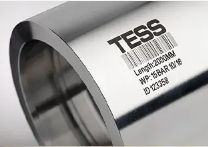
Metals (stainless steel, titanium, gold, silver, etc.)
Fiber laser: ✅ An excellent fit. Metals absorb its wavelength well. It's fast, gives high-contrast dark marks, can do deep engraving, and the machines are affordable with long life.
UV laser: ✅ It can also mark metals, but it's not the best choice. It's slower, weaker for deep engraving, and the equipment costs more to buy and maintain.
Bottom line: For metals → fiber laser is usually the better value (unless you need ultra-fine, heat-free marking for something like medical devices – then UV might make sense). Among metals, copper is a highly reflective material with poor light absorption, so fiber lasers may not be able to engrave it. UV laser is a good alternative.
Bottom line: For metals → fiber laser is usually the better value (unless you need ultra-fine, heat-free marking for something like medical devices – then UV might make sense).
Among metals, copper is a highly reflective material with poor light absorption, so fiber lasers may not be able to engrave it. UV laser is a good alternative.
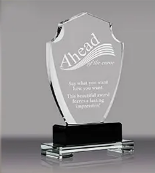
Other materials (painted/anodized surfaces, some ceramics, carbon fiber, dark engineering plastics like black ABS/PC, etc.)
Painted/anodized metal (removing just the coating): Both work well. UV won't hurt the base metal, fiber is fine too but may affect the substrate slightly. Either is OK – fiber is cheaper.
Dark engineering plastics (black ABS, PC, PA): UV is excellent – clear white marks, no deformation. Fiber can sometimes mark them but often causes yellowing or bubbling. UV is better.
Ceramics: UV gives fine, crack-free marks. Fiber can mark some ceramics but risks cracking. UV is safer.
Carbon fiber: UV is great (cold process, no fiber damage). Fiber is generally not recommended – it causes heat damage.
Bottom line: For these "other" materials, UV is usually the safer bet – better results and no damage. Fiber works on some coated metals and certain dark plastics, but the quality isn't as good.
If your material is neither heat-sensitive nor metal, we also have a CO₂ engraving machine for you to choose from.
Engraving Precision: UV Laser Engraver vs Fiber Laser Engraver
The difference in accuracy between UV and fiber lasers is significant – UV lasers are much finer.
Minimum spot size: UV lasers have a shorter wavelength (355nm), allowing them to focus down to 10–20 microns. Fiber lasers (1064nm) typically achieve 30–50 microns. The smaller the spot, the finer the line you can engrave.
Heat Affected Zone (HAZ): UV is a cold process with almost no heat, so edges are clean, without slag or burrs. Fiber lasers rely on heat, which often leaves some oxidation or spatter around the edges. For micro-patterns or tiny text, UV keeps strokes sharp, while fiber tends to produce "fuzzy" edges.
Achievable line width: UV lasers can consistently produce fine lines at 0.03–0.05mm (30–50 microns), and high-end models can even reach 0.01mm. Fiber lasers typically have a minimum line width around 0.1mm – any finer and lines may break or become unclear.
Depth control: UV lasers remove an extremely thin layer per pulse, making them ideal for shallow, high-precision gray-scale engraving or QR codes. Fiber lasers deliver higher energy per pulse, better suited for deep engraving, but struggle to control very shallow depths.
Bottom line: If your workpiece requires line widths under 0.1mm, text height within 1mm, or edge-free heat damage – such as chip marking, medical devices, jewelry micro-engraving – UV laser is the only choice. For general metal marking where extreme precision isn't critical, fiber laser accuracy is usually sufficient.
Use Scenarios: Fiber Laser or UV Laser Engraver?
Fiber Laser Use Scenarios
Fiber laser: serial numbers on hardware tools, logos on phone cases, engravings on jewelry, QR codes on mechanical parts, etc. It's fast, low-cost, and capable of deep engraving. For high-volume production line work—thousands or even tens of thousands of pieces per day—fiber laser is the most suitable choice.
UV Laser Use Scenarios
UV laser: PCB/FPC processing, chips and semiconductors, lithium battery processing, medical devices and consumables, medical packaging, luxury goods and jewelry, food and cosmetics, etc. These are the most extensive and in-depth application areas for UV lasers. It is primarily responsible for processing tiny components that require extremely high precision and minimal thermal impact.
Cost and maintenance: UV vs fiber laser engraver
Purchase Barrier & Cost
The purchase barrier for fiber lasers is much lower than that for UV lasers. With the same budget, you can get a higher-power fiber laser. Fiber lasers have essentially zero consumables, while UV lasers require thousands of yuan per year in crystal maintenance costs. Fiber lasers are nearly maintenance-free and suitable for ordinary factory environments, whereas UV lasers need dedicated care, environmental control, and more complex maintenance.
Daily Maintenance Workload
Fiber lasers are almost maintenance-free and suitable for ordinary factory environments; UV lasers require dedicated care and environmental control, and their maintenance is more complicated.
| Maintenance Item | Fiber Laser | UV Laser |
|---|---|---|
| Cleaning lenses | Simple wiping weekly | Careful cleaning weekly (more sensitive) |
| Environmental requirements | Ordinary workshop is fine | Air-conditioned room recommended; humidity 45%–75%, temperature 16–28°C |
| Preheating before startup | Not required | Needs 30 minutes of dehumidification before startup |
| Cooling method | Air-cooled (low power) | Water-cooled (needs regular water change / antifreeze) |
| Power on/off sequence | Arbitrary | Must turn on water chiller first, then laser; reverse for shutdown – sequence cannot be reversed |
| Failure rate | Very low, rugged and durable | Relatively high, especially power attenuation after crystal aging |
How to Choose Between Fiber Laser and UV Laser Engraver
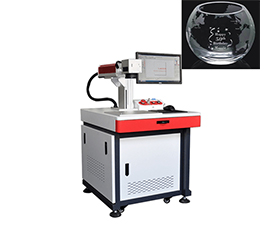
| Parameter | Details |
|---|---|
| Available Power | 3W, 5W, 10W |
| Engraving Depth (glass, multiple passes) | 0.01–0.05mm (3W) 0.05–0.1mm (5W/10W) ※ Cold process, shallow depth – mainly to avoid glass cracking |
| Application Scenarios | - Glassware: wine glasses, champagne glasses, beer mugs, trophies, decorative LED screens - Glass types: container glass, cast glass, pressed glass, float glass, flat glass, crystal glass, mirrored glass, etc. |
| Parameter | Details |
|---|---|
| Available Power | 20W, 30W, 50W |
| Engraving Depth | Depends on material and power; typically 0.1–0.5 mm for metals (deeper with multiple passes), slightly less for non‑metals |
| Application Scenarios | PCBs, electronic parts and components, integrated circuits, electrical appliances, shields, nameplates, hygiene products, metal hardware, fittings, PVC pipes, etc. |
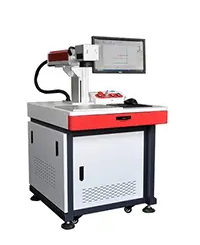
Here is a video on how to choose a fiber laser marking machine. If you have questions about selecting a fiber laser machine, you can take a look.
If you're not satisfied with marking on flat metal surfaces, you can check out our 3D fiber laser marking machine.
FAQ
A: Working principle: Fiber laser is a "hot process" (1064nm), melting material with heat. UV laser is a "cold process" (355nm), breaking molecular bonds with minimal heat.
Materials: Fiber excels at metals (stainless steel, aluminum). UV excels at heat sensitive materials (plastics, glass, ceramics, wood, leather, films).
Accuracy: UV has a smaller spot size (10–20μm) and can achieve line widths down to 0.03mm. Fiber has 30–50μm spot and ~0.1mm line width.
Speed: Fiber is faster (1,000–5,000 mm/s); UV is slower (100–1,500 mm/s).
Cost & maintenance: Fiber is cheaper ($1,500–4,000), has zero consumables, and is nearly maintenance free. UV is more expensive ($7,000–20,000), requires periodic crystal replacement, and needs controlled environments.
A:Clear/white plastics (no yellowing)
Flexible PCBs and rigid PCBs
Glass and ceramics
Medical devices and packaging (UDI codes, sterile marking)
Food and cosmetic packaging (direct date/lot coding)
Semiconductors and chips (ultra fine marking)
A:Electronics contract manufacturing (phone cases, earbuds, chip marking) – steady demand, good margins
Medical device UDI marking – strict compliance, customers willing to pay
Luxury goods & jewelry (anti counterfeit codes, logos) – high profit margins
EV battery traceability (lithium ion cells) – fast growing industry
UV lasers are especially competitive in these premium markets due to their precision and contamination free process.
A: The core component of a UV laser – the frequency doubling crystal – typically lasts 8,000 to 15,000 hours (depending on usage and maintenance). After that, the crystal needs replacement (costing roughly $400–1,000). With regular maintenance, the entire system can be used for 3–5 years before significant power drop, and replacing the crystal can extend its life.
If you are unsure whether to choose a UV laser en or a fiber laser for your material, you can contact us, and we will recommend the best solution for you.
Post time: Jun-03-2026