

Scaling Laser Etched Guitar Production: A Shop-Floor ROI Analysis
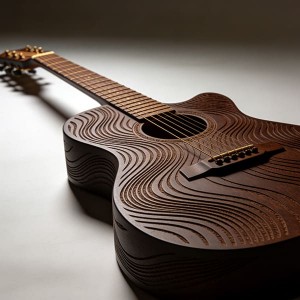
In the premium instrument market, a Laser Etched Guitar represents the perfect intersection of traditional lutherie and modern branding. However, for a factory, the "Laser Etched Guitar" is a strategic asset whose margin depends entirely on process stability. The true cost of production isn't the machine—it’s the risk of ruining a Grade-A substrate.
Mastering the Material: From Substrate to Finish
Creating a world-class Laser Etched Guitar begins with understanding wood science. Not all tonewoods react equally.
• Substrate Dynamics : While Maple yields sharp results, resin-heavy woods like Rosewood or Mahogany tend to produce oily residue. On the Mimowork 130, we solve this by bumping up the pulse frequency to "blast" oils away, ensuring every Laser Etched Guitar maintains a crisp, deep-contrast finish.
• The Protective Barrier : To ensure a "Zero-Soot" finish, we advocate for specialized Masking Tape. This ensures that the Laser Etched Guitar can go directly from the laser bed to the clear-coating booth, eliminating up to 20 minutes of sanding per unit.
Gantry Systems vs. 3D Galvo: Choosing Your Architecture
Choosing the right system architecture is critical for the long-term ROI of your Laser Etched Guitar production line.
| Feature | Gantry System (Mimowork 130) | 3D Galvo (Large-Field) |
|---|---|---|
| Working Area | Large (1300mm×900mm).Ideal for full-body Laser Etched Guitars. | Small to Medium. Usually limited to 300-600mm. |
| Curvature Method | Physical Z-Tracking. Best for deep, 100mm gradients. | Optical Lens Shifting. Faster, but shallower focus depth. |
| Production Scale | Matrix Efficiency (6+ units). | Single-unit branding. |
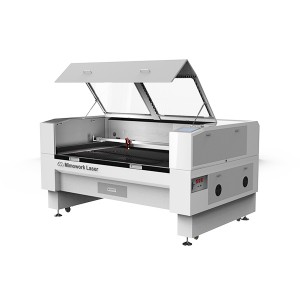
A compact laser cutter designed for precision guitar top plate cutting and engraving. The MimoWork Flatbed Laser Cutter 130 is ideal for processing tonewoods such as spruce, maple, and mahogany, delivering clean cuts for sound holes, rosettes, and decorative patterns.
With an optional 300W CO₂ laser tube, it can handle thicker wood boards, while the two-way penetration design allows longer guitar panels to pass through. For faster decorative engraving, the step motor can be upgraded to a DC brushless servo motor, reaching speeds up to 2000 mm/s.
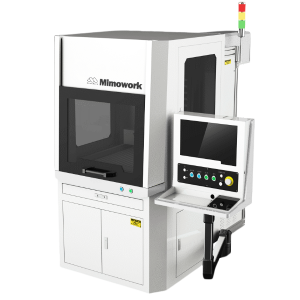
The Galvo 80 utilizes mirrors to move the beam at incredible speeds, while the totally enclosed design ensures a dust-free workspace. This high-dynamic response, combined with the 800mm× 800mm, allows for seamless etching of a large Laser Etched Guitar top, dramatically reducing cycle time compared to inefficient over-sampled rastering runs.
Mastering Complex Geometries: A Step-by-Step Approach
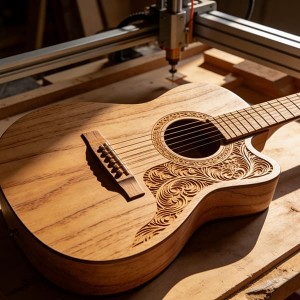
In premium instrument manufacturing, simply "marking" a pattern is not enough. Creating a world-class Laser Etched Guitar requires managing the rotational symmetry of the neck and the complex, non-linear contours of the body. Follow this industrial-grade workflow to achieve a boutique finish:
Step 1: Surface Pre-processing
Unlike common hobbyist materials, guitar tonewoods contain natural oils and fibers that react to heat.
• Masking: Apply specialized laser masking tape to the engraving area. This is the only way to prevent microscopic soot from migrating into the wood grain.
• Environment Check: Ensure high-pressure Air Assist is active to instantly "blast" away resinous vapors before they settle.
Step 2: Choosing the Setup (Neck vs. Body)
Depending on the component, select the appropriate "Curved Geometry" logic:
• The Neck: Utilize the Rotary Attachment. Secure the neck in the chuck so the laser beam remains perpendicular to the highest point of the cylinder throughout the rotation.
• The Arch-top Body: Lay the body flat on the machine bed. Instead of rotation, utilize the Mimowork 130’s Active Z-Axis Tracking to adapt to the body’s slopes.
Step 3: Focal Mapping & Height Initialization
This is the most critical stage for a high-end Laser Etched Guitar.
• Auto-Probing: Activate the displacement sensor to "map" the rise and fall of the 3D surface.
• Dynamic Range Setting: Ensure the total gradient is within the 100mm compensation range. The system will record this topography, ensuring the laser never loses focus while "climbing" the maple top.
Step 4: Optimizing Technical Specs
Fine-tune settings based on the specific tonewood (e.g., Maple vs. Rosewood):
• Acceleration: Set the acceleration to 4,000 mm/s². This prevents the laser from "lingering" at sharp turns in the design, eliminating charred edges.
• Frequency: For oily woods like Mahogany, increase the pulse frequency to physically flush out resins for a cleaner, higher-contrast etch.
Step 5: Framing & Matrix Preview
-
Framing: Run a red-light boundary test to confirm the artwork follows the body’s contours perfectly without overshooting the edges.
-
Matrix Setup: For mass production, arrange up to 6 bodies on the bed and confirm the starting coordinates for the batch run.
Step 6: Executing the Industrial Etch
-
Active Processing: Monitor the real-time movement of the Z-axis. You will see the laser head "dance" as it physically adjusts its height to match the guitar's curves.
-
Constant Energy Control: The system maintains uniform power density, ensuring the Laser Etched Guitar has consistent color depth from the center peak to the thinnest edge.
Step 7: Post-Process Finishing
-
Peeling: Remove the masking tape to reveal a "zero-soot" surface.
-
Ready for Coating: With no deep-sanding required, your Laser Etched Guitar is ready to move directly to the clear-coating booth.
Custom Engineering & Line Integration
Contact us for tailored hardware modifications to fit your existing guitar manufacturing workflow.
Technical Spec: The ROI of 4000 mm/s² Acceleration
When etching a high-end Laser Etched Guitar, acceleration is the only metric that dictates final quality.
The Mimowork 130’s 4000 mm/s² acceleration ensures heat input remains constant even at sharp corners. This eliminates the charred "hot spots" that ruin many Laser Etched Guitar projects. Combined with Matrix Production (processing up to 6 bodies simultaneously), it reduces cycle time by nearly 40%.
Custom OEM & System Integration
Need a specialized Laser Etched Guitar solution? Our engineers provide bespoke hardware modifications, from multi-head configurations to specialized bed sizes, ensuring seamless integration into your current CNC workflow.
Technical FAQ: Process Reliability
A: Power is secondary to dwell time. By optimizing power percentages at 400mm/s, the laser only reacts with surface fibers, achieving the desired aesthetic without impacting the guitar's resonance or structural integrity.
A: For wood and leather rastering, lead screws are traditionally too heavy and lack the necessary responsiveness. A high-quality belt system provides the superior acceleration and ROI required for these high-dynamic applications.
A: This is a common failure point on basic honeycomb beds. Our engineers noticed that laser backsplash can leave "grid marks" on the underside of a hollow body. On the Mimowork 130, we utilize a Knife Strip Table for acoustic guitars. By minimizing the contact area and using high-pressure air to dissipate heat downward, we eliminate back-side scarring entirely.
A: Experience shows that while a CNC is precise, it's a "one-at-a-time" process. By using a matrix-style laser setup, you can process 12 to 15 headstocks in a single 10-minute cycle. Compared to traditional CNC routing, this reduces the per-unit branding time by over 70%, allowing your CNC stations to focus on heavy wood-shaping tasks.
Evaluating Your Current Workflow:
If a production line is struggling with inconsistent depths, charred edges, or throughput bottlenecks, the solution is rarely "more power"—it is a more stable process.
We invite a direct comparison. By testing specific substrates (Ebony, Alder, etc.), we can provide exact data on the margin gains and yield improvements the Mimowork 130 offers for your laser etched guitar production.
Request a Live Material Test
Get Your Free Sample Pack


You may be interested in
Request a Live Material Test on Your Wood
Send us your Maple or Ebony; we’ll provide high-res results and precise cycle times.
Post time: Mar-05-2026