

CO2 vs Diode Laser for Acrylic: Can a Diode Laser Cut Acrylic?
How Diode and CO2 Lasers Actually Work for Cutting Acrylic
Diode laser: 445nm blue light. It passes straight through transparent materials. Only dark colors absorb it, which creates heat to cut or engrave.
CO2 laser: 10.6μm far-infrared light. Almost all types of acrylic — clear, colored, white — absorb it. That gives you stable cutting and clean edges.
Bottom line: Whether acrylic "absorbs" the laser is decided by wavelength, not just power.
Can a Diode Laser Actually Cut Acrylic?
Yes, but all three conditions below must be met. Miss any one — and it won't work.
| Works ✅ | Does NOT Work ❌ |
|---|---|
| Black | Transparent |
| Dark blue | White |
| Dark red | Light colors / Pink |
| Dark green | Frosted transparent |
| Opaque white (barely) | Fluorescent |
| Diode Power | Max Reliable Cutting Thickness |
|---|---|
| 5W | 2–3mm |
| 10W | 3–4mm |
| 20W | 4–5mm |
| 40W | 5–6mm |
| Comparison | Diode Laser | CO2 Laser |
|---|---|---|
| Cutting speed | Slow (100–150 mm/min) | Fast (500–2000 mm/min) |
| Edge finish | Matte / frosted | Can be flame‑polished (clear) |
| Batch production | Not practical | Highly efficient |
Who Are Diode Laser Cutting and CO2 Laser Cutting Suitable For?
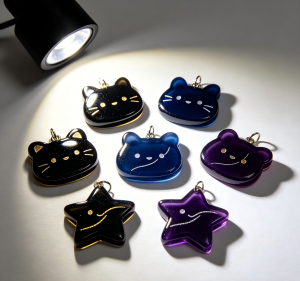
Who Is a Diode Laser Suitable For?
One sentence: A diode laser is suitable for hobbyists, DIY makers, and small workshops on a tight budget who only cut dark/black acrylic up to 5mm thick and don't need transparent acrylic, fast production, or polished edges.
Scenarios a Diode Laser Can Handle
- Black acrylic keychains, badges, nameplates
- Phone stands, puzzles, small desk decorations
- Model bases, electronic enclosure panels
- High‑precision photo engraving (diode actually has a smaller spot size than CO2)
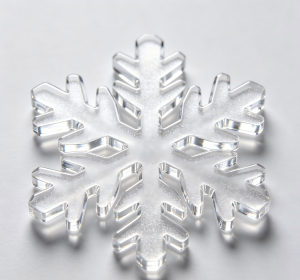
Who Is a CO2 Laser Suitable For?
One sentence: A CO2 laser is suitable for businesses, batch producers, and anyone who needs to cut any type of acrylic — transparent, dark, white, or colored — in thicker sheets (up to 20mm+), at high speed, with clean, polished edges.
Scenarios a CO2 Laser Can Handle
- Transparent acrylic LED signs, light guide panels, crystal letters
- Illuminated signs, display stands
- Thick acrylic (>6mm)
- All acrylic colors (black, white, transparent, colored)
CO2 Laser vs Diode Laser for Acrylic
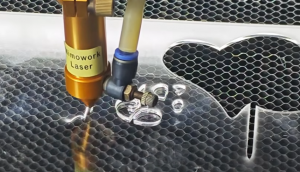
| Comparison | Diode Laser | CO2 Laser |
|---|---|---|
| Transparent acrylic | ❌ No | ✅ Yes |
| Dark acrylic | ✅ Yes (slow) | ✅ Yes (fast) |
| Max cutting thickness | ≤6–8mm | ≤20mm+ |
| Cutting speed | Slow | 5–10x faster |
| Edge quality | Acceptable, not polished | Can be flame‑polished |
| Engraving detail | Higher (smaller spot size) | Good |
| Equipment price | Low | High |
| Maintenance cost | Low | Medium (mirrors, tube life) |
Bottom line: A diode laser can only cut dark acrylic — it fails on transparent, white, or light colors. It's slow, limited to ≤6–8mm thickness, and leaves only matte edges. A CO2 laser cuts every type of acrylic (transparent, dark, white, colored) at 5–10x the speed, handles 20mm+ thickness, and delivers clean flame‑polished edges.
How to Set CO2 Laser Power Based on Acrylic Thickness
| Acrylic Thickness | Recommended Power | Recommended Speed (mm/s) | Passes | Notes |
|---|---|---|---|---|
| 5–8mm | 100W | 20–35 | 1 | Clean edges, can be transparent |
| 10mm | 100–120W | 12–20 | 1 | Air assist required |
| 15mm | 120–150W | 8–15 | 1–2 | Use focusing lens |
| 20mm | 150–200W | 5–10 | 1–2 | Strong exhaust + water cooling required |
| 25mm | 200–300W | 3–6 | 2–3 | High power tube advantage |
| 30mm+ | 300–500W | 2–4 | 2–4 | Extreme thickness cutting |
Our Acrylic 130 cutting machine can cut 21mm acrylic sheets. Click to see our material test.
If You Have to Use a Diode Laser to Cut Acrylic, Use These Parameters
| Diode Power | Max Thickness | Recommended Speed (mm/min) | Passes |
|---|---|---|---|
| 5W | 2–3mm | 80–120 | 2–3 |
| 10W | 3–5mm | 100–150 | 1–2 |
| 20W | 4–6mm | 150–250 | 1 |
| 40W | 6–8mm | 200–300 | 1 |
The Best Laser Cutters for Acrylic
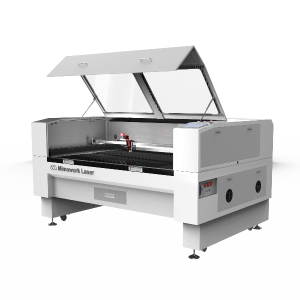
| Advantage | Description |
|---|---|
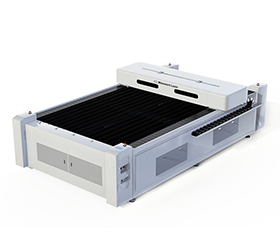
| High power (up to 300W) | Can cut very thick acrylic, expanding production diversity |
| Two‑way pass‑through design | Allows material wider than the cutting bed — ideal for long acrylic sheets |
| Multiple laser source options | CO2 glass tube (cost‑effective) or RF metal tube (longer life, better beam quality) |
| Suitable industries | Retail store signage, tournament brackets, small to medium advertising displays |
| Advantage | Description |
|---|---|
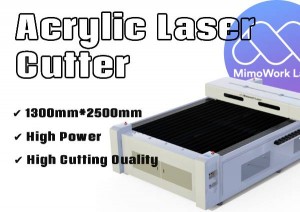
| Designed for large acrylic billboards and oversized wooden crafts | One pass, big sheet |
| Four‑way pass‑through | Handles extra‑long sheets with high flexibility |
| High‑speed cutting (36,000 mm/min) | Massive efficiency gain |
| Suitable industries | Large‑scale / batch production advertising displays, corporate signage, modern furniture |
Here is an operation video about cutting clear acrylic with a CO₂ laser. Follow along to learn more about this process.
Which of these two machines is the most suitable for you? Contact us to find out, and we'll give you the best recommendation.
FAQ
A: Usually no, or very poorly. White acrylic reflects and scatters the blue wavelength (~445nm) of a diode laser, so very little energy is absorbed. A 20W diode laser may only slightly mark or melt the surface, but it will not cut through. If you must use a diode laser for acrylic, stick with dark colors (black, dark blue, red) , use slow speeds, and multiple passes — but edge quality will still be far below CO2 results.
A:Yes. for 3–5mm dark acrylic.
A:Diode (smaller spot size)。
A: Yes, and it's excellent for it. CO2 lasers are the standard choice for cutting acrylic — both transparent and colored, cast or extruded. Depending on laser power, you can cut thicknesses up to 10–20mm. The cut edge often has a flame-polished, smooth finish. Just ensure proper ventilation, as melting acrylic releases a small amount of irritating vapor.
If you have any questions about cutting acrylic sheets with a CO₂ laser, contact us.
Post time: Jun-01-2026